
 Stripe MCP
On this page
Partly. The Stripe MCP server (https://mcp.stripe.com, in public preview) lets Claude, ChatGPT, Codex and Cursor look up customers, payments and refunds in your Stripe account, and search Stripe's own docs. It can confirm that a customer was charged twice. It can't tell you why: that's usually a retry in your own code, which Stripe never sees.
Duplicate charges are one of the most stressful tickets support gets. The customer is annoyed, the money is real, and the answer is split across Stripe, your logs and your code.
In this guide, I'll cover Stripe MCP setup, what support can safely check, and how to get from "two charges" to "here's what happened" in one pass. 👇
Key takeaways
- Stripe hosts the MCP server: point your client at
https://mcp.stripe.com, or runstripe agent setupto configure it automatically. - Two ways to sign in: OAuth (acts as your Stripe user) or an agent API key (independent, persistent access).
- It's good for "what happened in Stripe": find both charges, check refunds, read Stripe's docs.
- It can't see your retry logic: the cause of most duplicate charges lives in your code and logs.
- ✨ Supahelp is another option: it is built to check Stripe, your logs and your code together, on your own Claude plan, and to refund only after you approve.
What is the Stripe MCP server?
The Stripe MCP server gives AI agents tools to work with the Stripe API and to search Stripe's knowledge base, including documentation and support articles.
It's in public preview. Stripe recommends using its agent plugins, which configure the MCP server and install Stripe's skills for you. You can also set it up by hand in Cursor, Claude Code, Claude Desktop, Codex, ChatGPT and VS Code.
How do I set up Stripe MCP with Claude Code?
Install the Stripe CLI, open a new terminal, and run stripe agent setup. It detects which agents you use and configures each one.
To configure it manually, add an MCP server with the URL https://mcp.stripe.com. When you connect with OAuth, Stripe opens a consent screen in your browser.
Test tip: connect to a sandbox first. Stripe's docs nudge you there too. Ask for "every charge for customer cus_test_123 this month" and confirm the amounts match the Dashboard.
What support can check with Stripe MCP
- "List charges for billing@brightway.studio in the last 30 days, with amounts and timestamps."
- "Were any of those refunded? Partially or fully?"
- "Show the payment intent behind each charge. Do they share one, or are there two?"
- "What does Stripe recommend for preventing duplicate payments?" (searches Stripe's docs)
- "Is there an open dispute on either charge?"
Prompt 3 matters most. Two charges on two payment intents usually means your code created a second payment, not that Stripe charged twice.
Where it stops: the charged-twice ticket
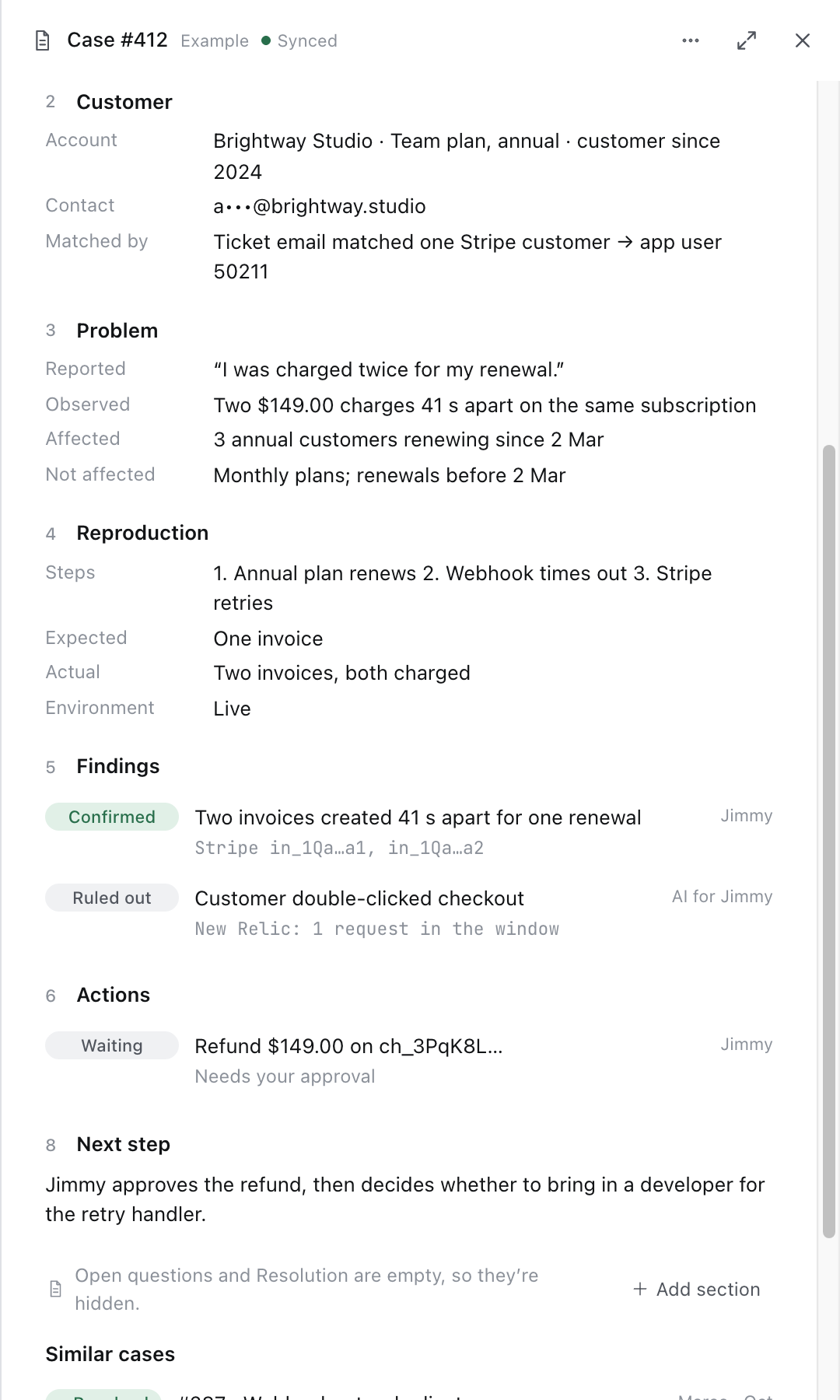
From Supahelp's example case #412 (labeled example data in the app):
Ticket: ZD #48213, "Charged twice in March" "I was charged twice for my renewal." (Brightway Studio, annual Team plan)
Stripe MCP finds two $149.00 charges 41 seconds apart on the same subscription. Good. But the customer will ask "was it me?" and "will this happen again?", and so will your finance team. The answers are elsewhere: New Relic shows only one checkout request, so it wasn't a double-click, and the second charge came from a webhook retry in the app's own retry handling.
Stripe can't see that. Your monitoring and your code can.
Using Stripe with Supahelp
Supahelp is built to connect Stripe alongside your helpdesk, logs and selected codebases, so it can find both charges and the reason for the second one.
Supahelp is a desktop app for Mac and Windows that runs on your own Claude or ChatGPT plan, or an API key. In the app's labeled example (a simulated preview), the chat for the Brightway Studio ticket:
- Reads the ticket in Zendesk and finds the customer.
- Checks Stripe: two $149.00 charges 41 seconds apart on the same subscription.
- Checks New Relic: one checkout request, so a double-click is ruled out. It looks like a webhook retry.
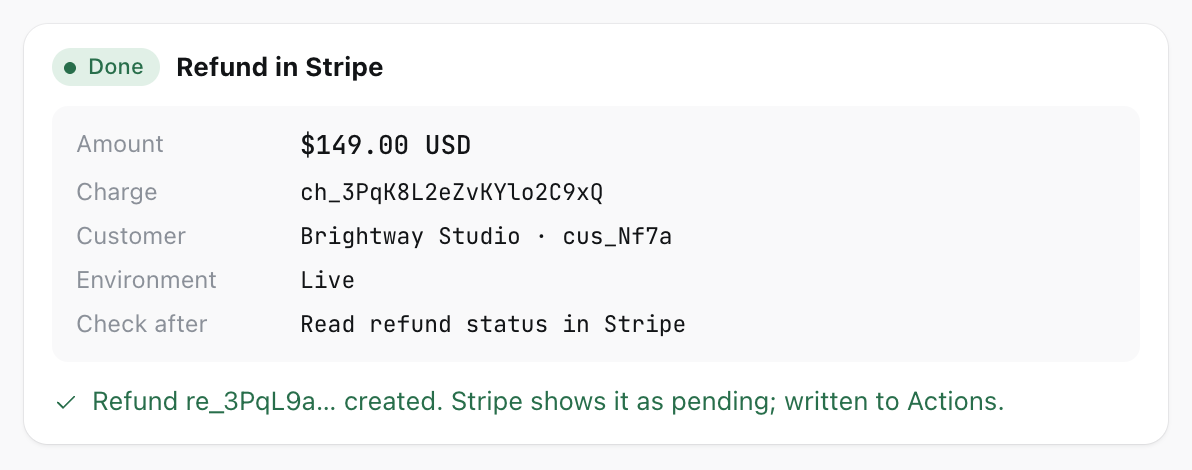
- Proposes the fix: a refund of the duplicate charge, and notes the retry handling probably needs a code fix.
- Asks first: by design the refund only runs after you approve, and Supahelp then reads the refund status in Stripe.
Pricing: free for personal use. Team plans and current prices are on the pricing page.
If you only need to look up payments from chat, Stripe MCP is enough. Supahelp is for the tickets where the customer, and your engineers, need to know why.
Stripe MCP safety checklist for support
- Start in a sandbox: test prompts before connecting live mode.
- Prefer OAuth for people: each person signs in as themselves. Use agent API keys only for automated jobs.
- Keep refunds behind a human: whatever tool you use, a person should approve every refund.
- Check the payment intent: one intent with two charges and two intents with one charge each are different bugs.
Conclusion
Stripe MCP is the fastest way to let Claude look up charges, refunds and disputes, and to search Stripe's docs. For a double-charge ticket, it confirms the "what" in seconds.
For the "why", you need your monitoring and logs in the same investigation. Supahelp is built to do that on your own Claude plan and to refund only after you approve.
You can start free on your own computer. 👇
Sources (checked 2026-11-20): Stripe Docs, "Model Context Protocol (MCP)" · Supahelp homepage demo · Supahelp pricing page.
Questions
Is the Stripe MCP server free?
Stripe hosts it for Stripe accounts, and it's in public preview. Your AI client may have its own plan requirements.
Can Stripe MCP issue refunds?
The MCP server works with the Stripe API, so write actions depend on what you authorize. Keep refunds behind a human approval step whichever tool you use.
Why would a customer be charged twice on Stripe?
Most often, your app created a second payment after a retry: a timed-out request sent again without an idempotency key, or a webhook that Stripe delivered again and your handler ran twice. Check whether the charges share a payment intent or invoice, and whether there was one checkout request or two.
Does Stripe MCP work with ChatGPT?
Yes. Stripe's docs list setup steps for ChatGPT, Claude Code, Claude Desktop, Codex, Cursor and VS Code.
Founder of Supahelp, the desktop app built to check your helpdesk, billing, logs and code for a support ticket and to ask before it changes anything.
 Ticket 48213
 Attio MCP
 Connectors