





On this page
A technical support engineer investigates and resolves customer problems that need technical depth: bugs, failed integrations, billing errors, outages. They read logs and errors, reproduce issues, work around them, and hand engineering precise bug reports. It's the role between front-line support and software engineering.
If you're hiring one, becoming one, or are one and wondering where the hours go, here's what the job actually involves. 👇
Key takeaways
- The job is investigation: "what happened, to whom, and why?"
- The tools are everyone's tools: helpdesk, error tracker, logs, issue tracker, billing, sometimes code.
- Most time goes to gathering context, not to the fix.
- Good escalations are a core skill: one message an engineer can act on.
- ✨ Supahelp is another option: it does the context-gathering across those tools on your own Claude plan, so you spend time on the answer.
What does a technical support engineer do?
A technical support engineer takes the tickets front-line support can't resolve and finds out what's really going on.
A typical day:
- Triage escalated tickets: real bug, configuration, or usage?
- Investigate: search logs, check errors, look up the account and payments.
- Reproduce the problem in a test environment.
- Work around it for the customer where possible.
- Escalate product bugs with evidence.
- Write it down: runbooks and known-issue pages so the next person is faster.
What tools do support engineers use?
| Job | Typical tools |
|---|---|
| The ticket | Zendesk, Intercom, Front, Plain, Pylon, Freshdesk |
| What broke | Sentry, Datadog, New Relic |
| Is it filed? | Linear, Jira, Shortcut, GitHub |
| Money | Stripe |
| Incidents | PagerDuty, incident.io, Rootly |
| Past answers | Slack, Notion, Confluence |
Support engineer vs software engineer
Support engineers diagnose problems in production for specific customers; software engineers build and change the product. Support engineers read code more than they write it, and their output is a resolution, a workaround or a precise bug report rather than a pull request.
Tier 2 vs tier 3
In many teams, tier 2 handles technical tickets with existing tools and knowledge, and tier 3 handles problems that need deep product or code knowledge, often with engineering. Technical support engineers sit at tier 2 or 3 depending on the company.
Where AI helps support engineers most
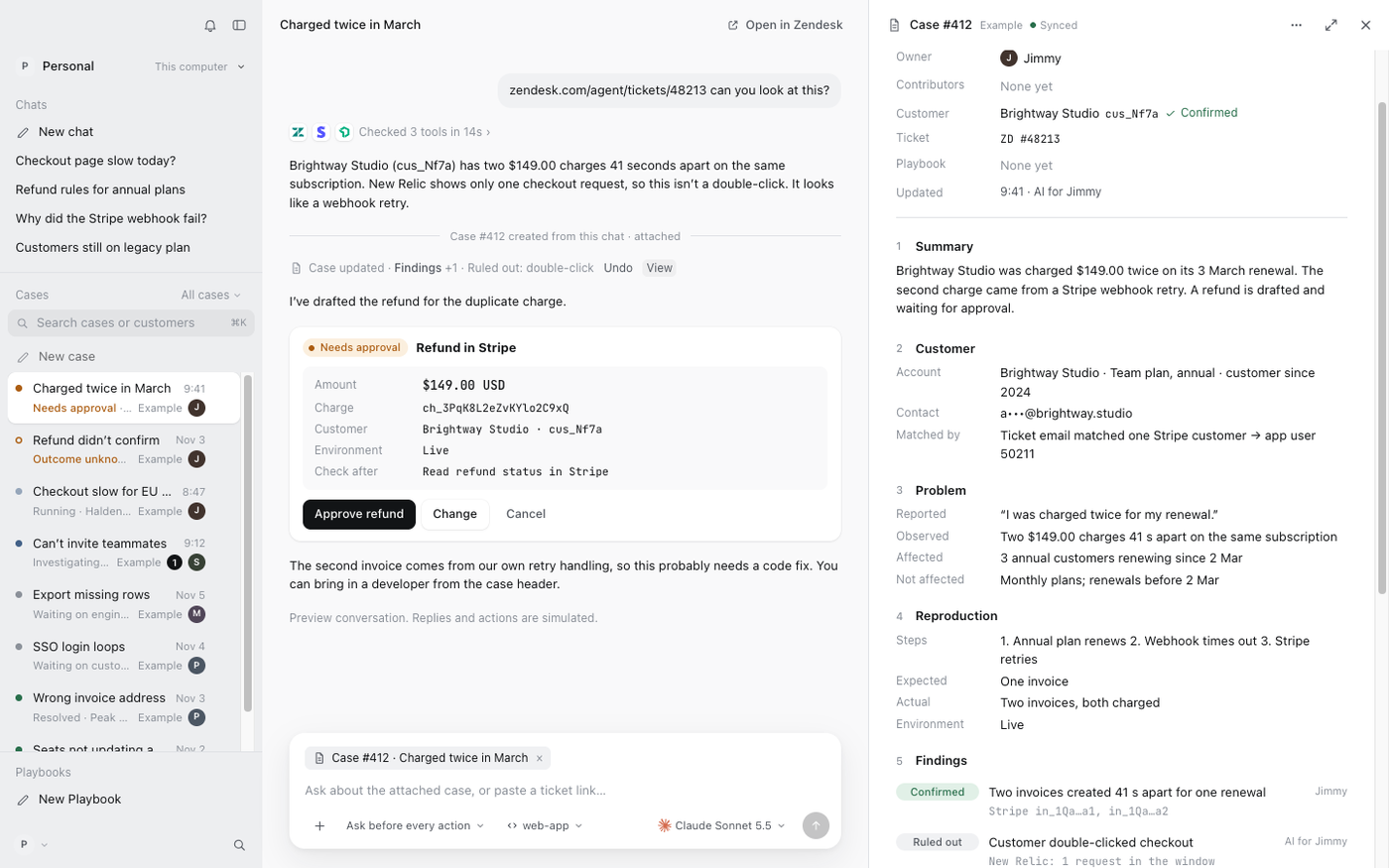
The biggest time sink is switching between six tools to build one picture. That's what AI with connected tools is good at: pulling the ticket, the error, the logs and the payment record together.
Where AI should not act alone: refunds, customer replies and anything that changes data. Those need a person's approval.
How Supahelp fits
Supahelp is a desktop app that investigates complex tickets across your helpdesk, error tracker, logs, issue tracker and billing, on your own Claude or ChatGPT plan, and asks before any change.
Pricing: free for personal use. Team plans and current prices are on the pricing page.
Conclusion
A technical support engineer is an investigator: they find what happened, to whom and why, then fix, work around or escalate it. Most of the time goes into gathering context from many tools. Supahelp takes that part on, so the engineer can focus on the answer. 👇
Questions
Is a technical support engineer a real engineer?
They use engineering skills (reading code, logs and systems) to diagnose problems, but their main output is resolutions and bug reports, not new features.
What skills does a support engineer need?
Clear writing, comfort with logs and error trackers, basic SQL or API knowledge, and the patience to reproduce problems precisely.
How do I become a technical support engineer?
Many come from front-line support and learn the technical tools, or from engineering and move toward customers. Being able to write a precise bug report is the skill that gets noticed.
Founder of Supahelp, the desktop app built to check your helpdesk, billing, logs and code for a support ticket and to ask before it changes anything.
 Attio MCP
 Connectors