Every request in one queue.
The team side of Supahelp. Triage, assign, and resolve every support request from one workspace — the customer's answers, your internal discussion, and the full history together on every request.
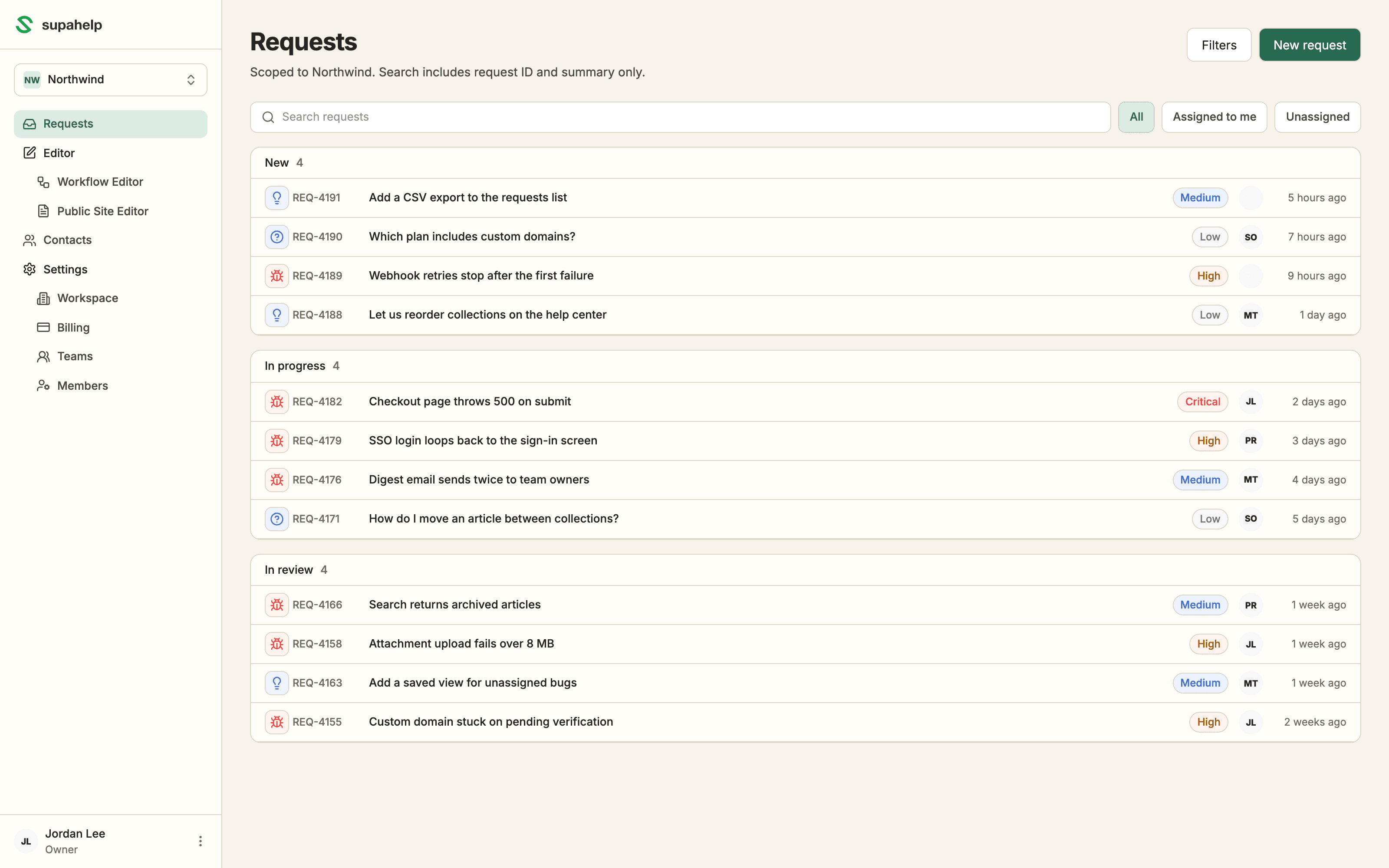
What your team sees first: every request grouped by status, with owner, severity, and age at a glance.
How it works
One queue, one place to work it.
Every request lands in the same queue — whether it came from your help center's request form, a customer's reply to an email, or one you logged by hand. The queue is grouped by status, so what is new and what is waiting is the first thing you see.
Open a request and it is all on one screen: the answers the customer submitted, the internal thread your team is working in, and the properties down the side. Status, severity, assignee, and team are set inline, and every change is written to the activity timeline — the history of a request never leaves the request.
Internal comments stay internal. @mention a teammate to pull them in as a follower. And because every request is tied to a contact, the next time that person writes in you already have everything they have filed before.
What it does
Built for whoever picks up the queue.
The requests are already coming in. The work is making sure each one has a status, an owner, and a place the whole history lives.
One queue
Grouped by status
New, in progress, on hold — the whole queue in the order you work it.
Filter to what's yours
By assignee, severity, or type. Keep the views you check every morning.
Search that finds it
By request ID or summary. No full-text guessing.
Fast triage
Set it from the request
Status, severity, assignee, and team are one click, inline.
Typed on the way in
Bug, Question, Feature request, Feedback — colour-coded from the form.
Route to a team
Hand a request to Payments or Onboarding without losing sight of it.
Work it together
A thread per request
Discuss the fix where the request lives, not in a side channel.
@mention to bring someone in
They join as a follower and stay in the loop on changes.
Attachments stay attached
Logs and screenshots live on the request, not a chat scroll.
Nothing slips
A full activity timeline
Every status change, assignment, and comment, with who and when.
Customer replies land here
Follow-ups attach to the original request, not a new ticket.
History by contact
Every request a person has filed, on their record.
Also included. Teams, labels, primary followers, an AI summary of each request thread, and unlimited requests and members on every paid plan.
Who it's for
Why teams outgrow the shared inbox
The trigger differs by team. What they share is a support load that a shared mailbox stops being able to hold.
SaaS support teams
Requests arrive in three inboxes and a Slack channel
Nothing has an owner until someone volunteers, and the quiet ones age out of sight. One queue with a status and an assignee on every request keeps the oldest unanswered thing visible — and makes it someone's.
Every request has an owner
Product and ops teams
Bug reports and feature requests share one inbox
A shared inbox has no severity, no routing, and no history. Here a request carries its type, severity, team, and the contact who filed it, so the queue is something you can actually review in a weekly triage.
Reviewable in a standup
Solo founders
You are the entire support team
You do not need a workflow — you need to not drop things. Statuses, a saved “unassigned” view, and a contact history are enough structure to stay on top of support between everything else.
Enough process, no overhead
Frequently asked questions
Where do requests come from?
Your published help center's request form, replies to customer emails, and requests your team logs by hand all arrive in the same queue.
Can customers see our internal comments?
No. Internal comments and the activity timeline are visible only to your team. Customers see the reply you send them, nothing else.
Can I assign requests to a specific team?
Yes. Route any request to a team, set an assignee and a primary follower, and filter the queue by any of them.
Does it keep a history of changes?
Yes. Every status change, reassignment, property edit, and comment is recorded on the request's activity timeline with the person and the time.
Do I need engineering to set this up?
No. The workspace is built for support and product teams to run their queue without an engineering dependency.