What is the difference between Help Scout and Intercom?
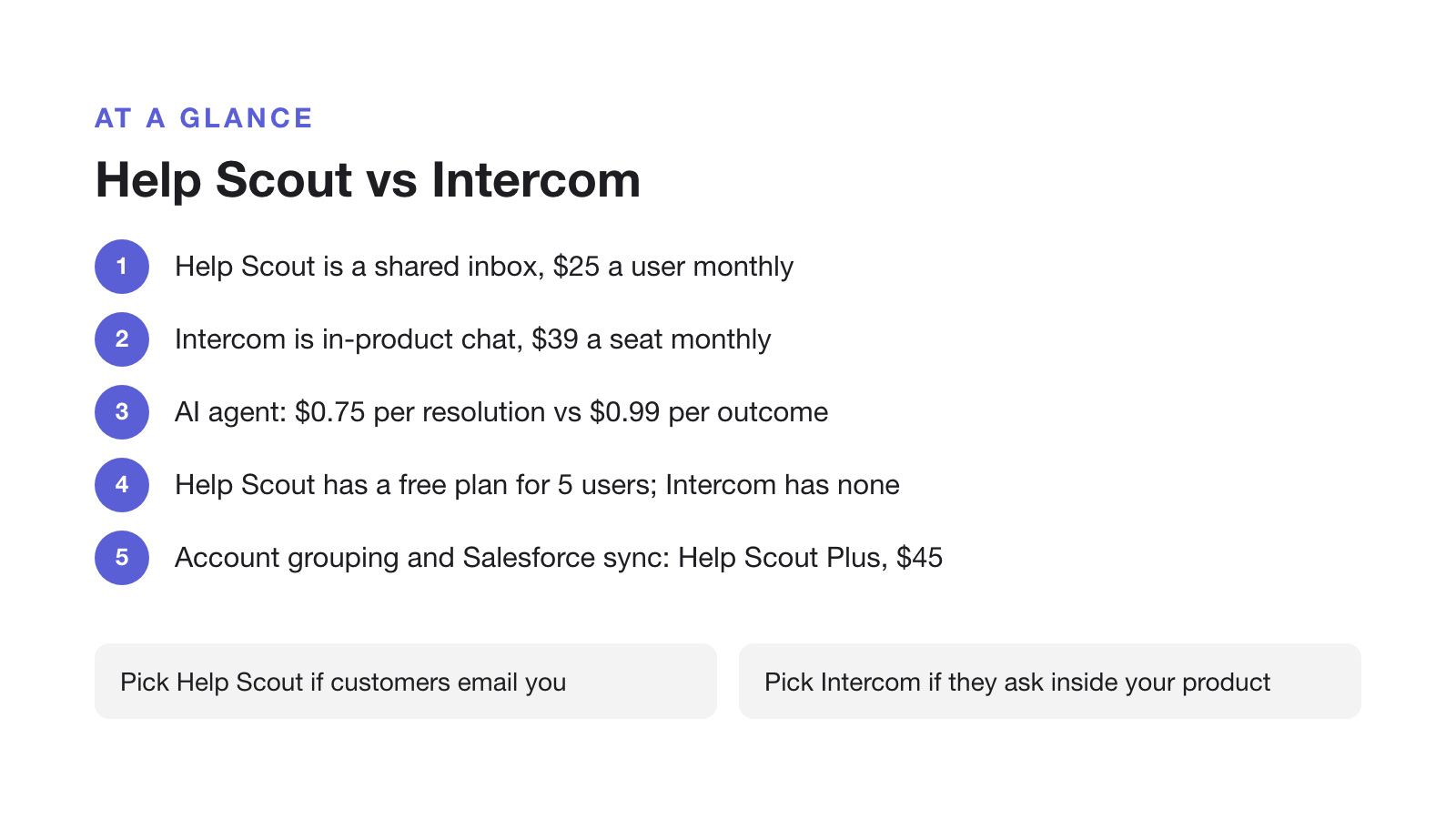
Help Scout is a shared inbox first: email, live chat and messaging in one place, with a knowledge base and a per-resolution AI agent. Intercom is built around the Messenger, a chat window inside your product and website, with its Fin AI agent answering first and a team inbox behind it. For a B2B SaaS team, the choice usually comes down to where customers start the conversation: by email, or inside the product.
Prices come from both vendors’ pricing pages on 29 October 2026. We make Supahelp, a third option covered at the end.
| Feature | Help Scout | Intercom |
|---|---|---|
| Built around | A shared inbox for email, chat and messaging | In-app and website chat (the Messenger) with an AI agent |
| Seat price, monthly billing | Standard $25, Plus $45, Pro $75 per user | Essential $39, Advanced $99, Expert $139 per seat |
| Seat price, annual billing | 16% off | Essential $29 ($19 for new customers), Advanced $85, Expert $132 |
| Free plan | Yes: 5 users, 1 inbox, 1 Docs site | No; free trial |
| AI agent for customers | Envoy (AI Answers), $0.75 per resolution, 3-month free trial | Fin, $0.99 per outcome |
| AI for your team | AI inbox assistant on Standard; unlimited AI Drafts on Plus | Copilot, $29 per agent; 10 free conversations a month |
| Knowledge base | Multiple Docs sites on Standard | Public help center on Essential; private and multilingual from Advanced |
| B2B account features | Group conversations by company; Salesforce, Jira and HubSpot integrations (Plus) | Ticket types for customer, back-office and tracker tickets |
| SSO and HIPAA | Pro | Expert |
| Light seats | Up to 50 on Pro | 20 free on Advanced, 50 on Expert |
Which is cheaper, Help Scout or Intercom?
Help Scout, on both seats and AI. On monthly billing, its Standard plan is $25 a user against $39 for Intercom Essential, and its AI agent is $0.75 per resolution against $0.99 per Fin outcome. Help Scout also has a free plan for up to five users, which Intercom does not.
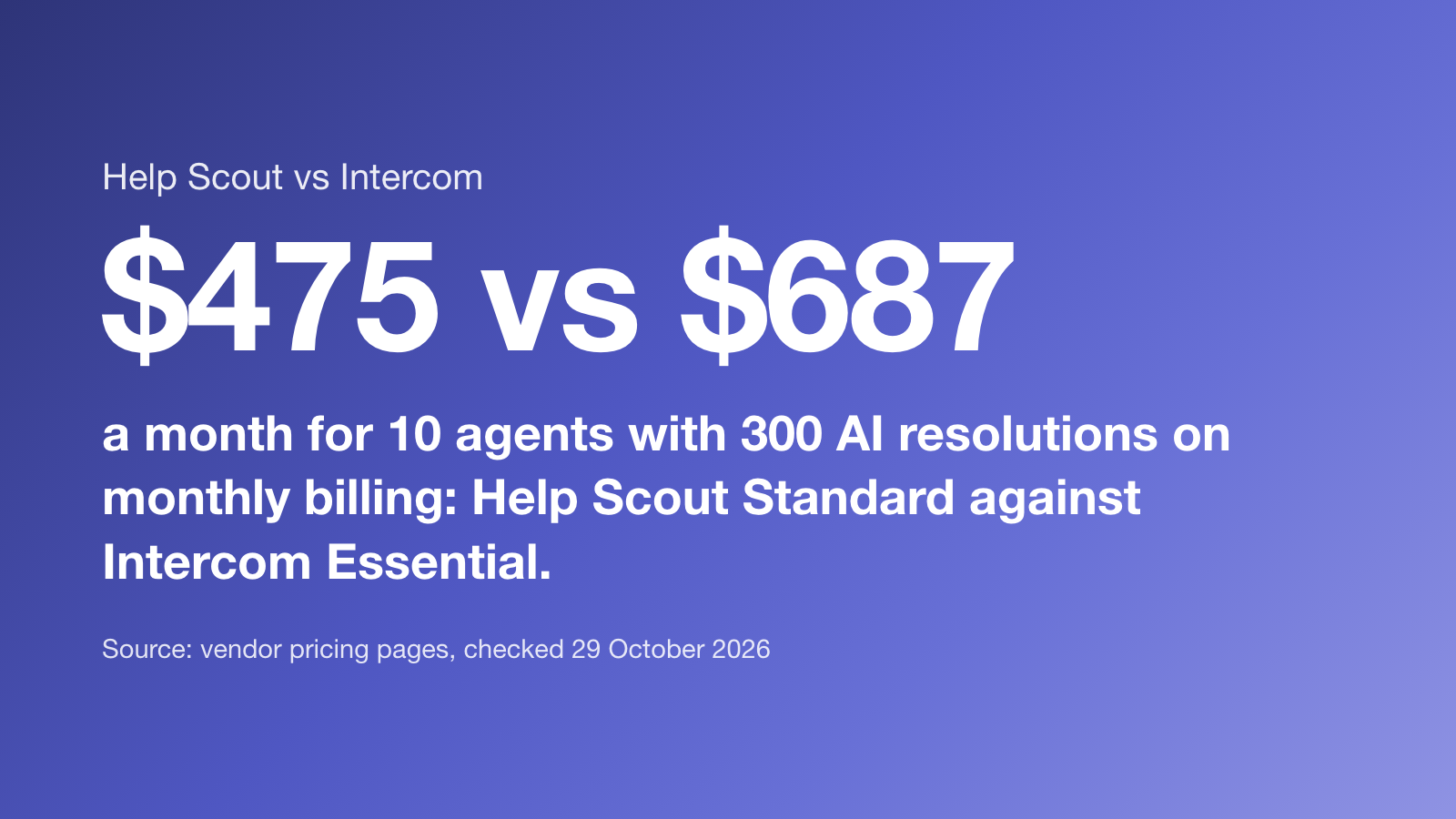
The table uses monthly billing on both, because Help Scout lists its monthly price, and assumes 300 AI resolutions a month.
| Team | Help Scout Standard | Intercom Essential |
|---|---|---|
| 3 agents | $75 + $225 = $300 | $117 + $297 = $414 |
| 10 agents | $250 + $225 = $475 | $390 + $297 = $687 |
| 25 agents | $625 + $225 = $850 | $975 + $297 = $1,272 |
The features many B2B teams want, such as grouping conversations by company and syncing with Salesforce, sit on Help Scout Plus at $45 a user. Intercom’s workflows and round-robin assignment sit on Advanced at $99 a seat monthly. At ten agents that is $450 against $990 a month before AI. Our Intercom pricing guide covers the new-customer discount and what counts as a Fin outcome.
How their AI compares
- Billing unit. Help Scout charges per resolution. Intercom charges per outcome, which also counts conversations where the customer simply doesn’t reply after Fin’s answer.
- Trying it. Help Scout’s AI agent comes with a three-month free trial.
- Drafts for your team. Help Scout includes unlimited AI Drafts on Plus. Intercom’s Copilot is $29 per agent after 10 free conversations a month.
- Human approval. Intercom can hold Fin’s answers for a teammate on topics you choose, with Human in the Loop. We compare approval options in AI help desks that require human approval.
Which should a B2B SaaS team choose?
- Choose Help Scout if most customers email you, you want conversations grouped by account, and you’d rather pay less per seat and per AI resolution.
- Choose Intercom if customers ask for help inside your product, you want an AI agent that answers chats first, and you also use in-app messages and product tours.
- Choose neither if you want one flat price as the team grows, structured forms for bug reports and feature requests, and AI replies that wait for a teammate’s approval. Supahelp, for example, is $64 a month billed annually for unlimited staff. It has no live chat, so it is not a fit if in-app chat is your main channel.
For more options, see Help Scout alternatives and Intercom alternatives. This page was last updated on 30 October 2026.