What is cost per AI answer?
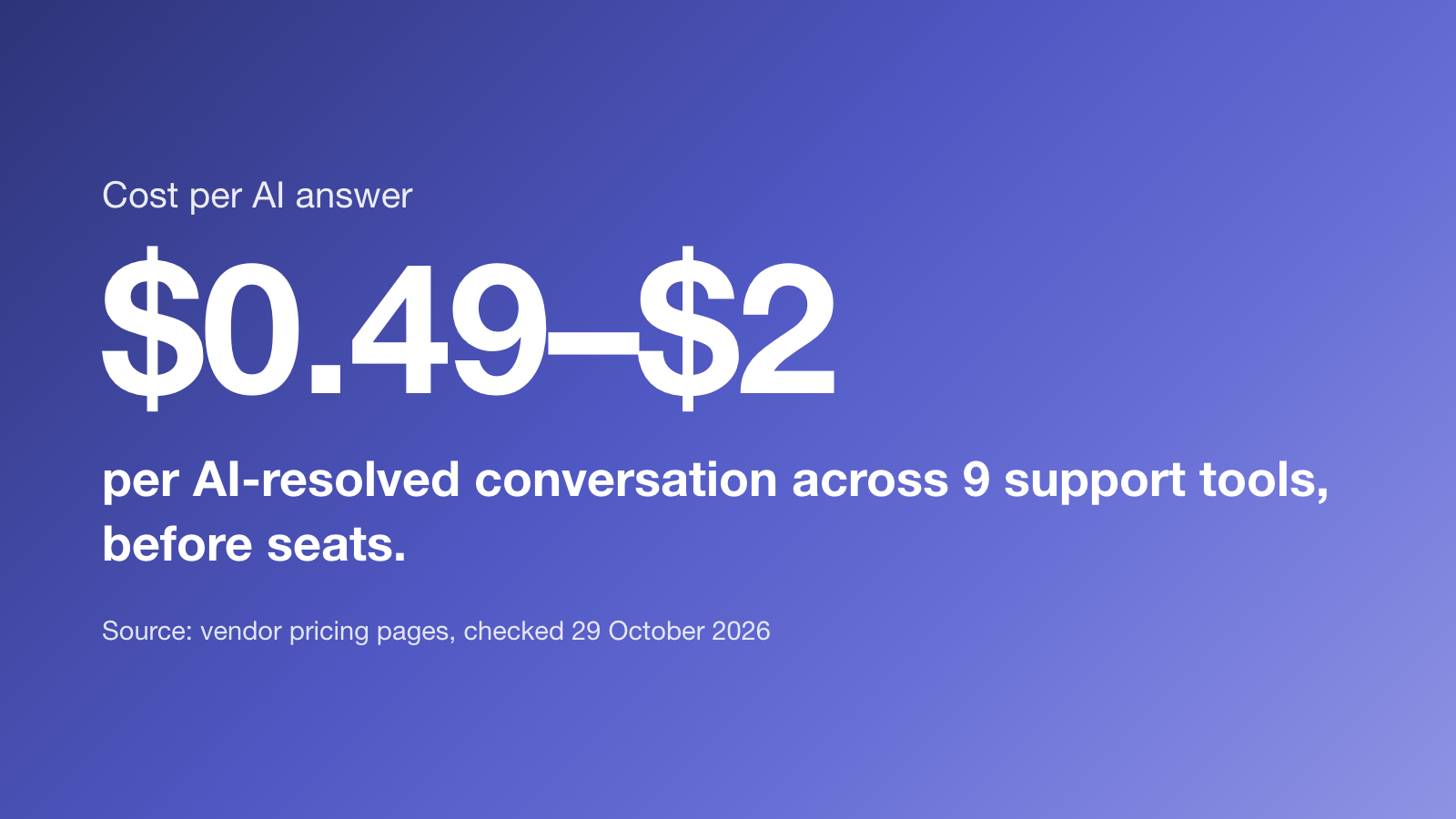
Cost per AI answer is what a support tool charges each time its AI handles a customer question. It is the number to compare once AI support moves past a free trial, because seat prices no longer tell you the bill. The catch is that every vendor counts a different unit, so the headline prices are not directly comparable.
Prices come from each vendor’s pricing page, checked on 29 October 2026. We make Supahelp, which is on this list.
| Tool | What it counts | Price per unit | Included |
|---|---|---|---|
| Featurebase (Fibi) | Resolution | $0.49 | None; handovers to a person are free |
| Freshdesk (Freddy AI Agent) | Session | $0.49 ($49 per 100) | 500 free sessions, once per account |
| Help Scout (AI Answers) | Resolution | $0.75 | None |
| Intercom (Fin) | Outcome | $0.99 | None |
| Jira Service Management | Resolution | $1.00 | None listed |
| Zendesk (AI agents) | Automated resolution | $1.50 committed, $2.00 pay-as-you-go | 5 per agent a month |
| Gorgias (AI Agent) | Automated interaction | $1.50 past the plan limit | 30 a month on Starter and Basic |
| HelpCanvas | Chatbot conversation | Included | 1,000 a month on the $29 Pro plan |
| Supahelp | Answered question | Included | About 500 a month (5,000 credits) on the $64 Essential plan |
The four units vendors count
- Resolution or outcome. You pay only when the AI resolves the conversation without a person. Intercom also counts it when the customer simply doesn’t reply after Fin’s answer. Featurebase, Help Scout, Intercom, Jira Service Management and Zendesk work this way.
- Session. You pay for every conversation the AI takes part in, resolved or not. A Freshdesk email session covers 72 hours from the customer’s first email.
- Automated interaction. Gorgias counts what its AI Agent handles past the number included in your plan.
- Included allowance. HelpCanvas and Supahelp include a monthly amount in a flat price. Supahelp spends 10 credits for each question it answers from your articles and nothing when it finds no answer. Its 5,000 monthly credits are shared with request summaries, and there is no way to buy more, so AI answers stop when they run out.
What 500 AI conversations a month cost
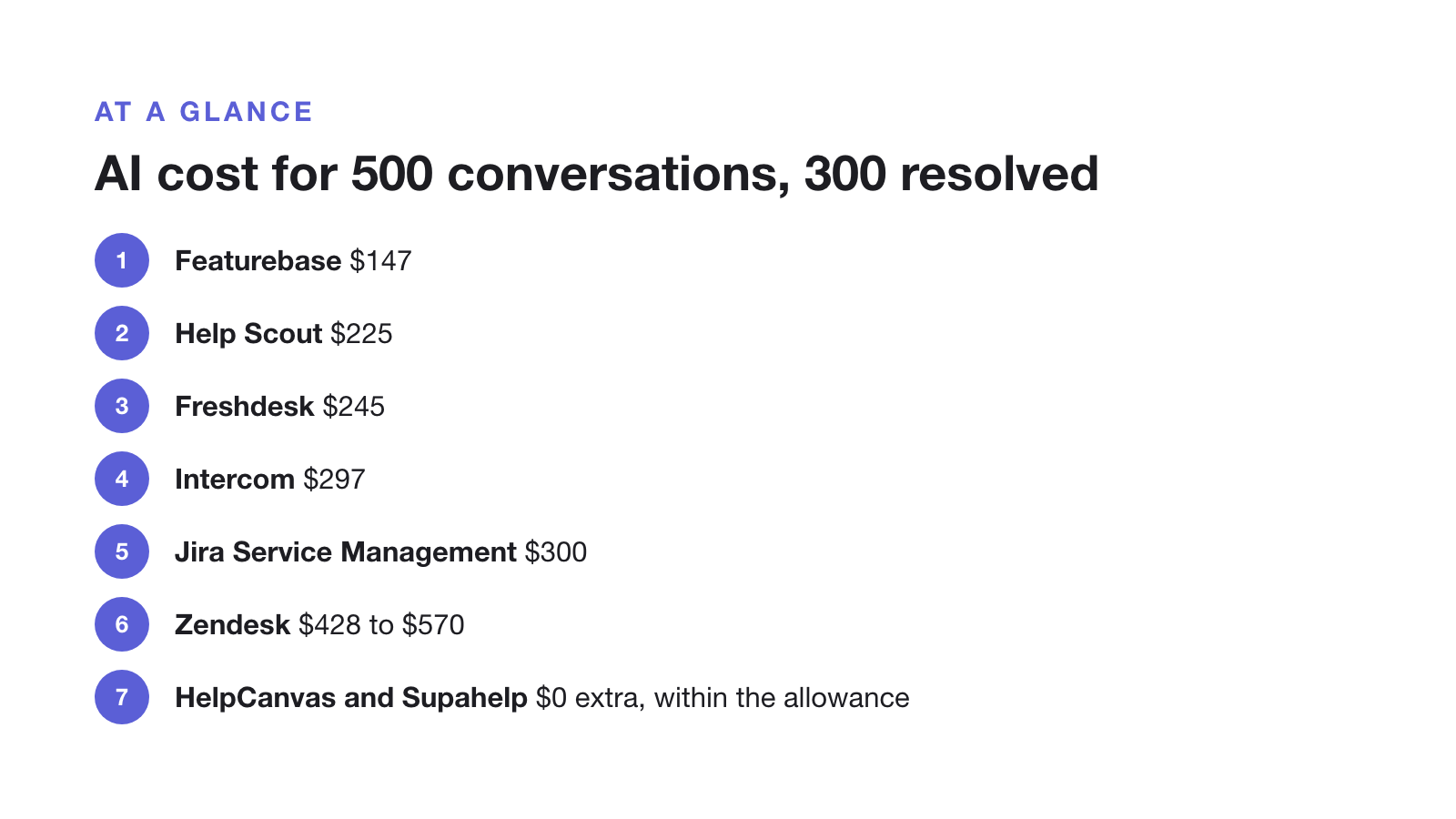
To compare like for like, take a three-agent team whose AI handles 500 conversations a month and resolves 300 of them without a person. The table shows the AI charges only, before seats.
| Tool | How it's counted | AI cost a month |
|---|---|---|
| Featurebase | 300 resolutions × $0.49 | $147 |
| Help Scout | 300 resolutions × $0.75 | $225 |
| Freshdesk | 500 sessions × $0.49, after the free 500 are used | $245 |
| Intercom | 300 outcomes × $0.99 | $297 |
| Jira Service Management | 300 resolutions × $1.00 | $300 |
| Zendesk | 285 resolutions past the 15 included × $1.50 or $2.00 | $428 to $570 |
| HelpCanvas | Within 1,000 included conversations | $0 extra |
| Supahelp | Up to 500 answered questions, the whole monthly allowance | $0 extra |
Gorgias is left out because its plans are sized by ticket volume, so the result depends on which plan the store is on.
Per-resolution pricing looks expensive per unit but charges nothing for the conversations the AI fails on. An included allowance costs nothing extra until the cap, then stops. At this volume Supahelp would use its entire allowance, so a team that expects to grow past 500 AI answers a month should pick a per-resolution tool.
How to estimate your own cost
- Count last month’s questions. Use conversations or tickets that a help article could have answered, not every ticket.
- Assume a modest resolution rate. Vendors quote their best customers. Start with your own trial numbers, or a cautious guess, and multiply.
- Add the seats. AI pricing sits on top of a per-agent plan for most tools. Our Zendesk pricing and Intercom pricing guides work through full bills at 3, 10 and 25 agents.
- Check the ceiling. With an included allowance, find out what happens at the limit: a top-up, a higher plan, or no more AI until next month.
Whatever the price, the AI can only answer what your articles cover. Our guide to structuring a knowledge base for AI answers is the cheapest way to raise the share of questions it resolves.