What is a CSAT score?
CSAT, short for customer satisfaction score, is the share of customers who rate a support interaction as good. You usually ask one question right after a request is resolved, such as “How satisfied were you with the help you got?” on a 1 to 5 scale. CSAT is the number of 4 and 5 ratings divided by all ratings, times 100.
For example, if 200 customers answer and 164 pick 4 or 5, your CSAT is 164 ÷ 200 × 100 = 82%. Tools calculate it slightly differently, so compare your score with your own past months rather than with another company’s.
What actually moves CSAT
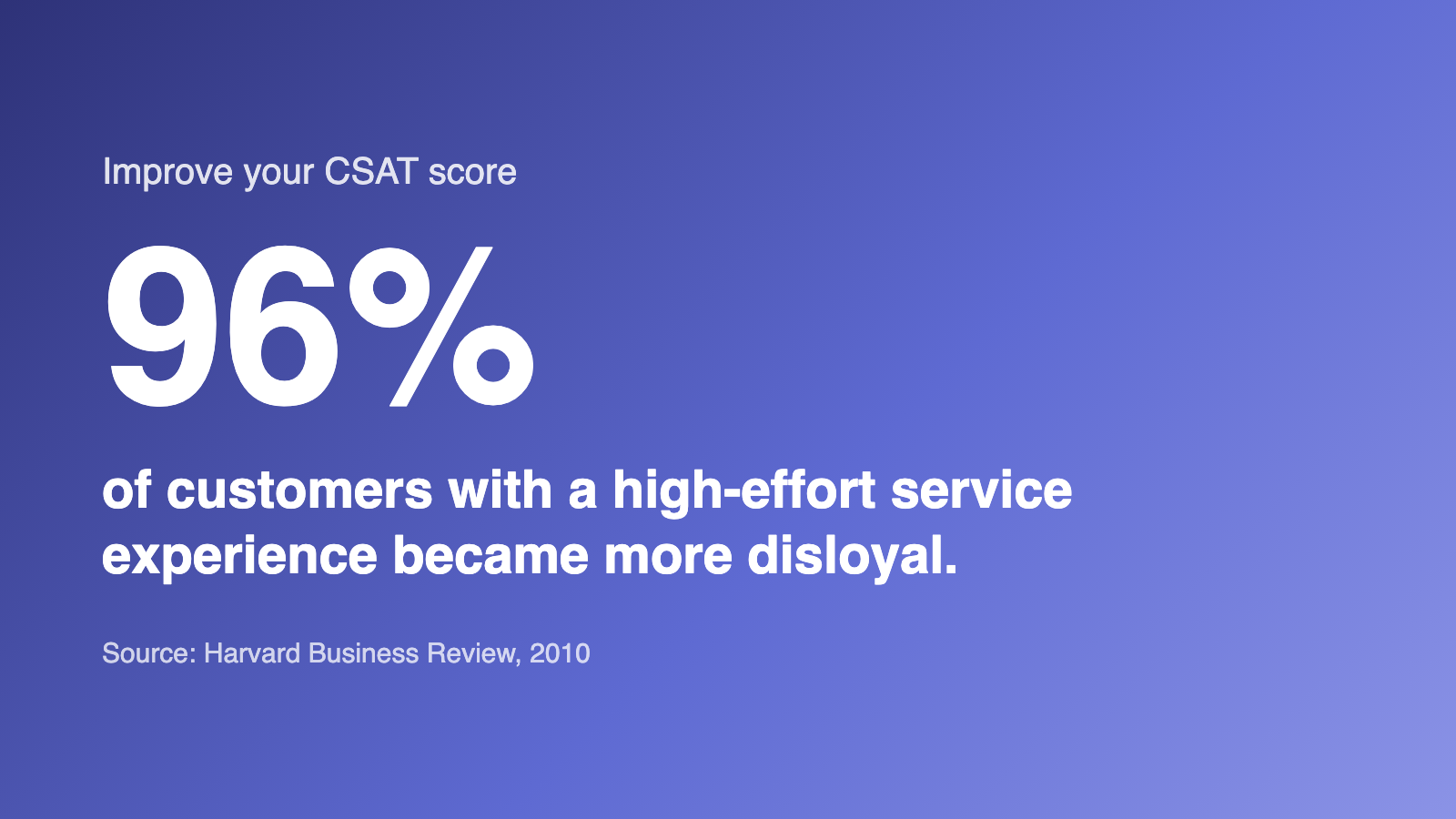
Customers rate how easy it was to get their problem solved more than how friendly the reply was. A study of more than 75,000 customers published in Harvard Business Review found that 96% of customers with a high-effort service experience became more disloyal, compared with 9% of those with a low-effort one. Going above and beyond made little difference. Solving the problem quickly and simply did.
More recent research points the same way. In Zendesk’s CX Trends 2026 report, a vendor survey of more than 11,000 consumers and business leaders, 74% of consumers said they get frustrated when they have to repeat information, and 85% of CX leaders said one unresolved issue is enough to lose a customer.
| What frustrates customers | Fix | Why it works |
|---|---|---|
| Having to repeat themselves | Pass the full conversation on every handoff | 74% of consumers say repeating information frustrates them (Zendesk, 2026). |
| Waiting for a reply to a simple question | Answer repeat questions in the help center | The fastest reply is the one the customer finds without asking. |
| Being bounced between people | Give every request one owner | Each handoff adds effort and another wait. |
| A reply that doesn't solve it | Aim to resolve in the first reply | 85% of CX leaders say one unresolved issue is enough to lose a customer (Zendesk, 2026). |
| Not knowing what happens next | Say who owns it and when they'll hear back | Uncertainty feels like effort even when the wait is short. |
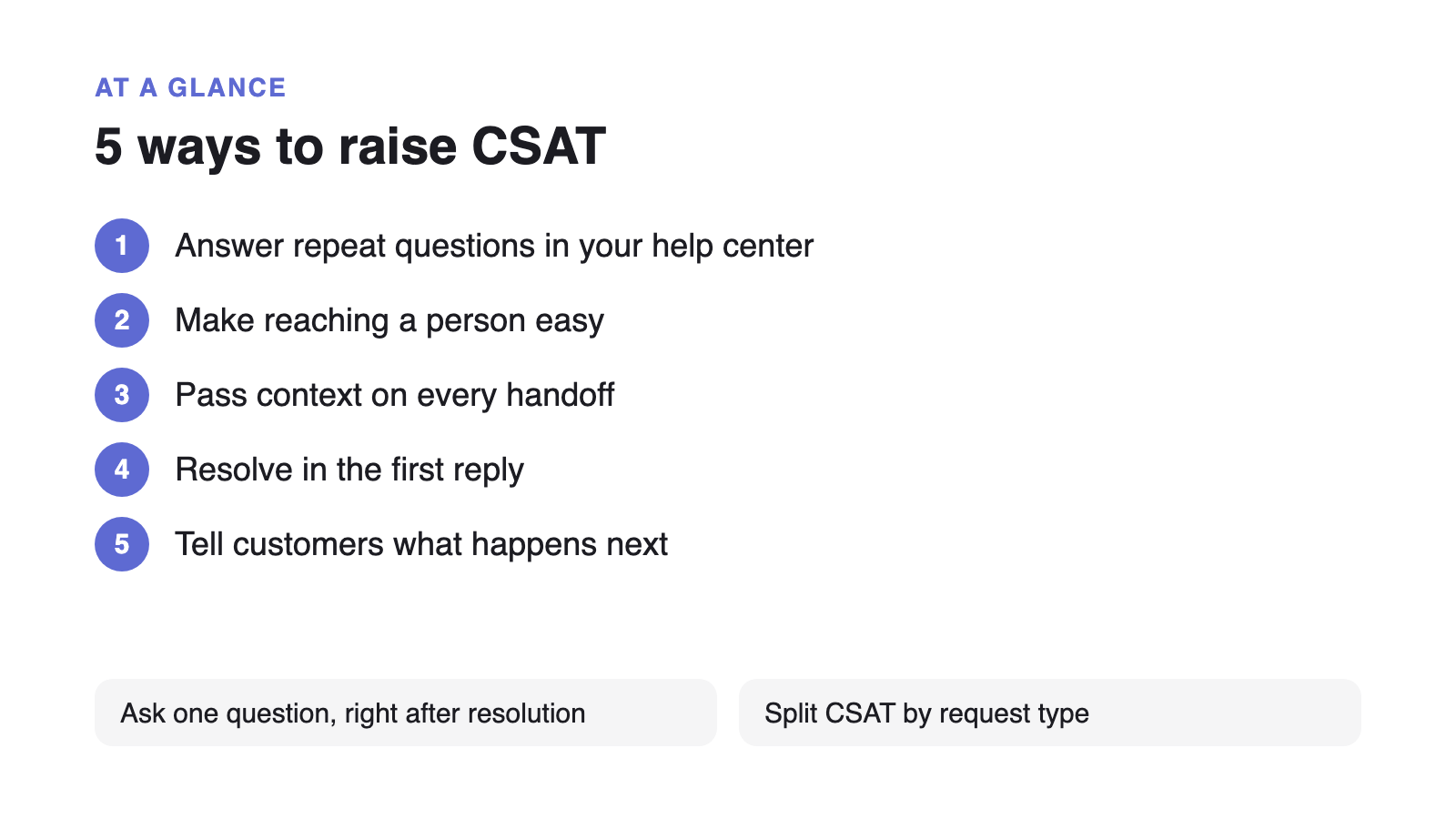
Six ways to raise CSAT without hiring
None of these need more agents. They cut the effort a customer spends getting to an answer, which is what the score mostly measures.
- Answer repeat questions before they're asked
Find the 10 to 20 questions that fill your queue and write a clear help article for each, then link them from the contact form.
- Make reaching a person easy
Put a visible contact option on every help article and AI answer. Hiding it raises effort and lowers the score.
- Pass context on every handoff
Whoever picks up a request sees what the customer already searched, read and said, so they never ask twice.
- Put what agents need in one place
Show the relevant article and the customer's key account details next to the request, so replies are faster and more complete.
- Resolve in the first reply
Include the full answer, the link and the next step, instead of asking a follow-up question you could have answered.
- Tell customers what happens next
If it can't be solved now, say who owns it and when they'll hear back. Then keep to it.
The first step does the most work, because a question answered by a good help article never reaches your queue at all. Our guide on how to reduce support tickets shows how to find those questions and write the answers. The fourth step matters because every tab an agent opens adds wait time for the customer, which we cover in cutting tab-switching on support requests.
How to measure CSAT so the number means something
- Ask once, right after resolution. A survey sent days later measures memory, not the interaction.
- Keep it to one question plus an optional comment box. Every extra question lowers the response rate.
- Split it by request type. An average across billing, bugs and how-to questions hides the one category that is dragging the score down.
- Read the low scores. The comments on 1 and 2 ratings usually point to a missing article, a slow handoff or a policy customers don’t understand.
- Wait for enough responses. With twenty ratings a month, one unhappy customer moves the score five points. Look at the trend over a quarter.
Does AI help or hurt CSAT?
It depends on the handoff. In a Gartner survey of 5,728 customers, 60% said their main worry about AI in customer service was that it would make it harder to reach a person. An AI that answers simple questions from good articles and passes everything else to your team with the conversation attached lowers effort. One that blocks the way to a person raises it, and the score follows. Our 30-day AI help desk rollout plan covers the handoff rules.