What does tab-switching cost a support agent?
Each switch costs a little over two seconds, and that is exactly why it goes unfixed. Two seconds does not feel like a problem to the person spending it. The cost only appears in the count.
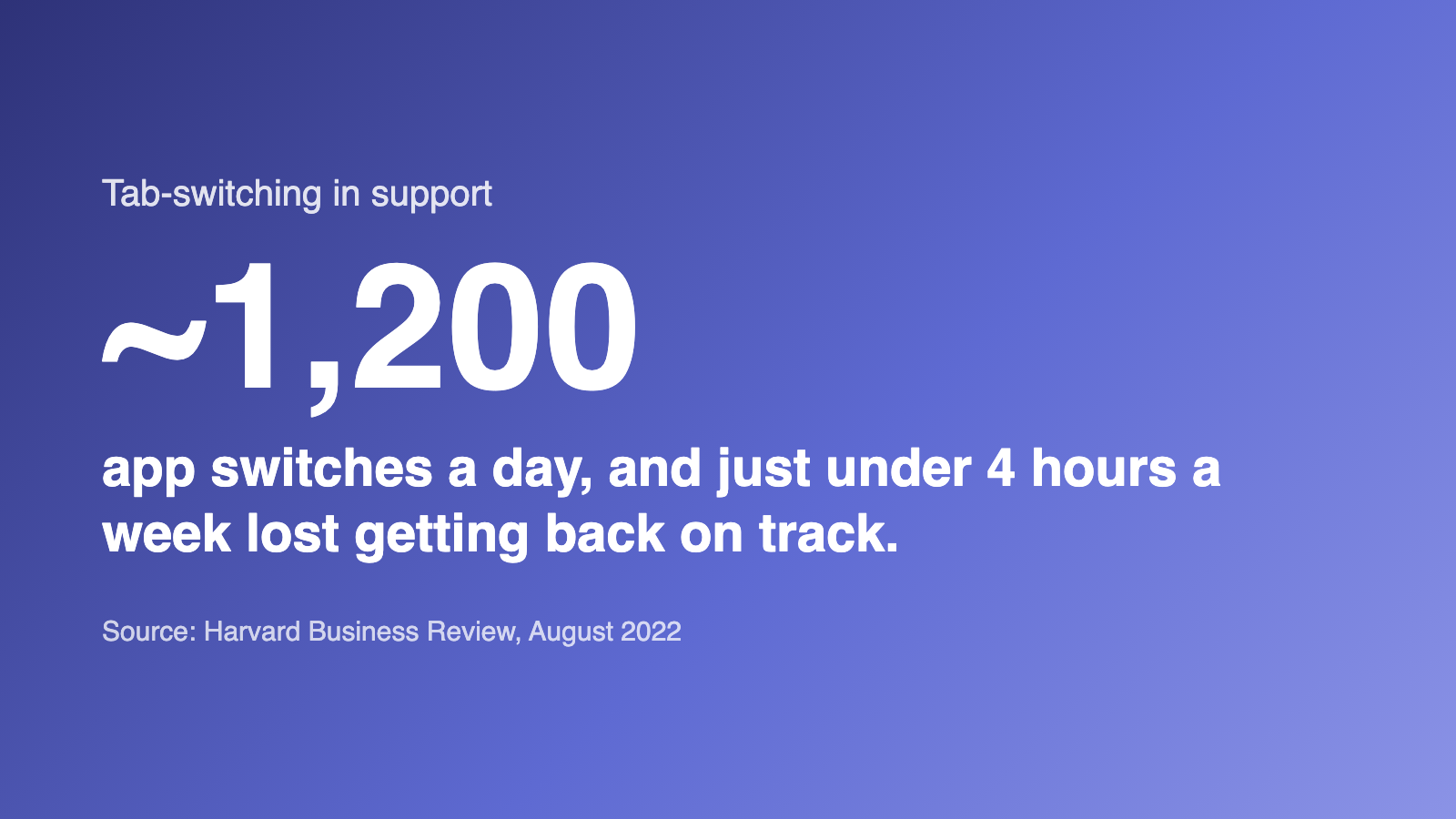
An August 2022 Harvard Business Review study by Rohan Narayana Murty, Sandeep Dadlani and Rajath B. Das instrumented 137 users across 20 teams at three Fortune 500 companies, covering roughly 3,200 days of work. Those users toggled between applications nearly 1,200 times a day. Reorienting after each switch cost just under four hours a week, around 9% of annual working time, or about five working weeks a year.
One finding in that study matters more than the headline number. After 65% of switches, the user switched again within eleven seconds. The time spent in the destination barely exceeded the cost of getting there. People were not going somewhere to work. They were going somewhere to look.
Support work concentrates this pattern, because a support agent does the looking with a customer waiting. The same two seconds are spent under a response-time target, several times per reply, across every request in the queue.
The four tabs behind every support request
A support agent answering one request usually crosses four destinations: the request itself, somewhere holding the answer, somebody who knows the answer when that fails, and the system holding the customer’s account. Different companies name these differently. The shape does not change.
Read those questions again and notice what they assume. The four tabs are a given. The system, the article and the internal chat are all still there, and the agent’s job is to move between them gracefully. The expected answers are keyboard shortcuts.
The table below takes the same four destinations and asks a different question: what would have to be true for the agent not to go there at all.
| The tab | Why it opens | What removes it |
|---|---|---|
| The request itself | It is where the customer's question lives | Nothing. This is the one destination that should stay open the whole time. |
| A knowledge base article | The agent knows the answer exists but not the exact wording | Search the knowledge base from inside the request and insert the answer without changing context. |
| Internal chat | No article covers it, or the agent does not trust the one that does | Write the article the first time a question is escalated. The second person to ask should hit the knowledge base instead of a colleague. |
| The system of record | The answer depends on this customer's plan, invoice or account state | Surface the two or three fields agents actually check next to the request. The rest stays a click away. |
| A previous ticket | Someone answered this before and the wording was good | Make resolved requests searchable alongside articles, then promote the good answers into articles. |
| The public help center | The agent needs the article URL to send to the customer | Link to the article from the composer, so the customer receives the same source the agent read. |
Why “get faster at switching” is the wrong fix
Training agents to switch faster cannot work, because there is almost nothing left to shave. The switch already costs two seconds. Even a heroic improvement returns a fraction of a second, multiplied by a number of switches that stays exactly the same.
The lever is the count, not the duration. Removing one routine lookup from every request removes it from every request in the queue, every day, for every agent. That is a change to how the work is arranged, and it is not something an individual can be trained into.
There is a second cost that never shows up in a time study. The internal chat tab is not a tool, it is a colleague. Every escalated question spends someone else’s attention, and that person is usually the one who can least afford it. A support queue that routes around a missing article turns senior staff into a lookup service, and nothing about that is visible in handle time.
This is the same problem as reducing support volume, pointed inward. A question a customer had to ask twice is a missing public article. A question an agent had to ask twice is a missing internal one. Both are the same knowledge base with different visibility.
How do you collapse the four tabs into one?
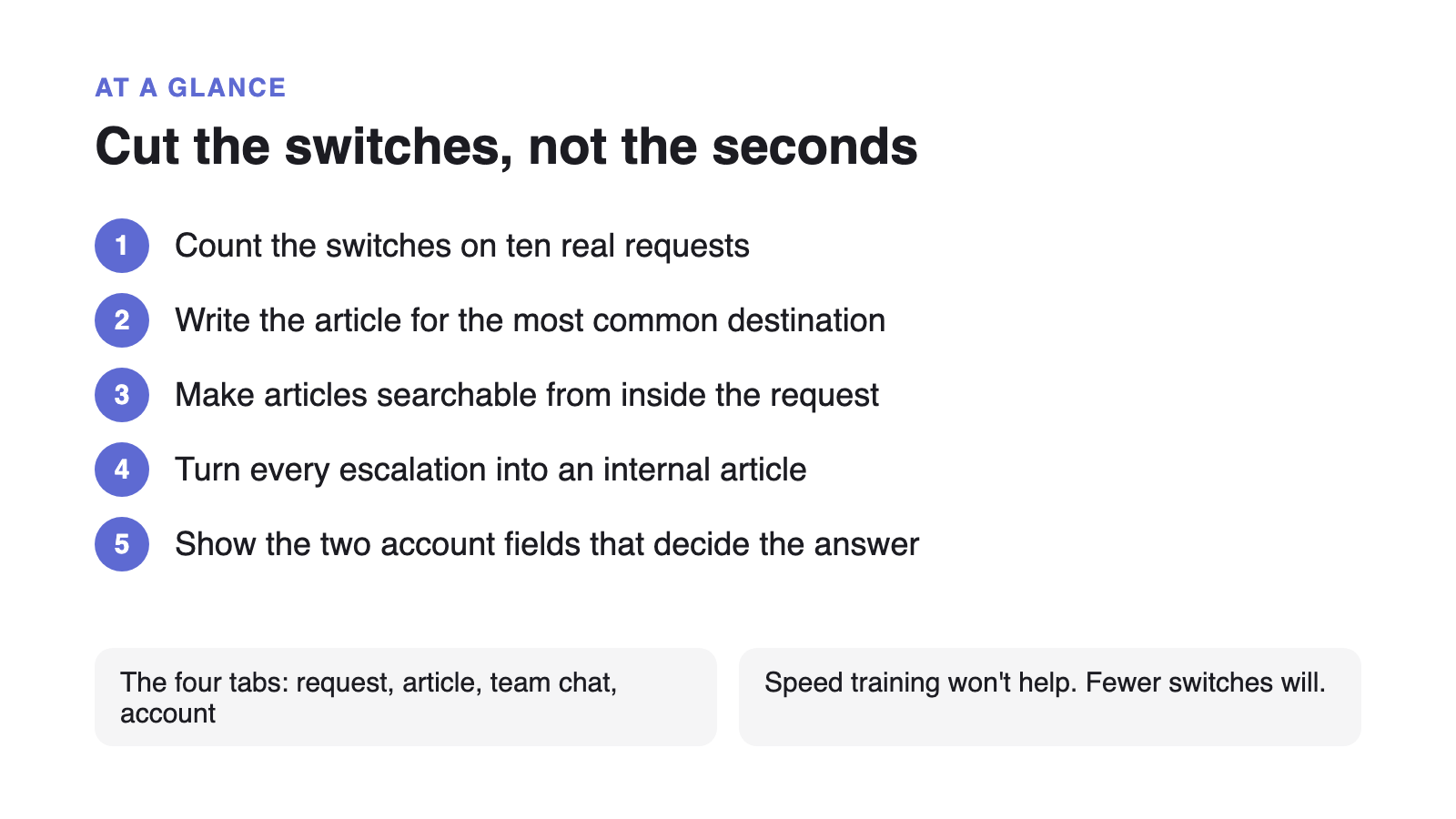
Collapse them by moving the answer to the request instead of moving the agent to the answer. In practice that means five passes, in this order, because each one makes the next cheaper.
- Count the switches on ten real requests
Screen-record ten requests end to end and tag every switch with what the agent went to get. Ten is enough. The same three or four destinations show up every time, and the count is your baseline.
- Write the article for the most common destination
Whatever agents leave the request to look up most often is your next article. One question, answer in the first forty words, phrased the way it gets asked.
- Make that article findable without leaving the request
The agent should search and insert an answer in the same view as the reply. If your current tool cannot do this, it is the single feature worth migrating for.
- Turn every escalation into an internal article
When a question goes to a colleague, the answer becomes an article before the request closes. Otherwise the same colleague gets asked again next week, and the knowledge stays in one person's head.
- Surface the two account fields that decide the answer
Skip the full CRM view. Find the handful of fields agents check on nearly every request, such as plan, renewal date and last invoice, and put those beside the conversation.
The measurement that tells you it worked is not handle time. It is the number of destinations an agent visits per request, which you can count from ten screen recordings in an afternoon. Handle time moves for a dozen reasons. Switch count moves only when you remove a reason to switch.
What to look for in a tool
Look for one where searching the knowledge base and replying to the customer happen in the same view, without a second window. Everything else in a support platform comparison is downstream of that, because it is the switch that happens on nearly every request.
Two details are worth checking before you commit. Whether internal and customer-facing articles live in one library with per-article visibility, or in two products you keep in sync by hand. And whether the article the agent reads is the same article the customer gets sent, so that improving one improves both.
If your requests still arrive in a shared mailbox, the switch count problem and the queue problem are worth solving together, since the inbox is where you will find the next twenty articles. And when you do write them, write them so that retrieval can quote them cleanly, because an assistant that answers from a good article is the last version of this fix: the lookup happens, and nobody switches tabs to do it.